
Statewood Pond Upgrades
Statewood Pond Upgrades - BMGCA in collaboration with the City of Ottawa
The BMGCA has been meeting and consulting with the City of Ottawa regarding the Statewood Pond stormwater facility (SWF). The summary below assesses the Statewood Pond exploring issues, alternatives, and improvements for its pond and water management system. To see a detailed view on the City of Ottawa’s assessment, options and plan, please see this presentation – City Presentation_June 15_2026_optimized Below is a summary of the presentation.
Facility Overview and Conditions
- The pond was built in 2006 with two cells separated by a retaining wall and a clay liner.
- Water levels are low in the upper cell, and there are concerns about the retaining wall's stability.
- Phragmites growth is observed in the lower cell, and previous liner repairs were ineffective.
- The upper cell functions as an infiltration basin, with rapid draw-down in the lower cell.
Condition Assessment and Findings
- An engineering consultant conducted field investigations, borehole testing, and structural assessments.
- Groundwater monitoring and site inspections revealed water loss and connectivity between aquifers.
- The existing armour stone wall shows no structural risk, but infiltration issues persist.
- The facility's stormwater performance and safety were evaluated, highlighting short draw-down times.
Alternative Solutions for the Pond
- Maintain existing conditions with landscaping improvements at a low cost.
- Re-line the upper cell with a geosynthetic liner to restore hydraulic function.
- Convert the upper cell into a dry pond, reducing infiltration and water quality benefits.
- Transform the upper cell into a wetland to enhance ecosystem creation and stormwater management.
Improvements Applicable to All Alternatives
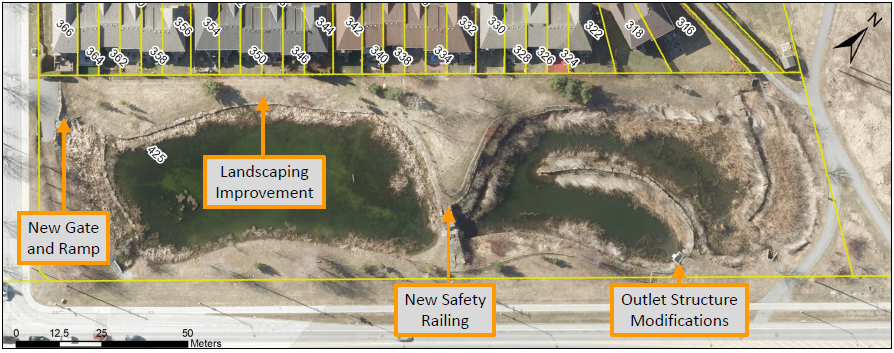
- Installation of a new gate ramp near the upper cell inlet.
- Modifications to outlet structures to improve drawdown times.
- Addition of safety railings on the armour stone wall.
Cost and Comments on Each Alternative
- Maintaining existing conditions costs $100K, offering high stormwater management performance.
- Re-lining costs $960K, with concerns about algae odor and catchment size.
- Converting to a dry cell costs $550K, resulting in loss of permanent water levels.
- Creating a wetland costs $250K, providing high stormwater performance and ecosystem benefits.
Preferred Solution and Recommended Measures
- The recommended approach includes landscaping improvements, a new gate ramp, safety railing, and outlet modifications.
Based on the presentation above, the City has the following recommendation.
We will proceed with the City’s recommended approach, which is to maintain the existing conditions in the upper cell and implement the following actions:
· Landscaping improvements: We will enhance landscaping around the upper cell (trees and shrubs). We will coordinate with Forestry to prepare a draft landscaping plan, which will be shared with residents for review and feedback.
· Outlet structure modifications: We will proceed with modifications to the pond outlet structure located at the far east corner of the lower cell. This work is anticipated to occur later this summer and is expected to take approximately 2–3 weeks, with only minor disruptions. Once the work is complete, there will be no change to the normal water level in the lower cell, aside from a slightly slower decline following rainfall events.
· Access improvements: A new gate will be installed in the existing railing on the west side of the facility to improve access for maintenance equipment (e.g., mowers).
· Safety measures: We will continue to explore options to discourage the public from crossing the facility via the armour stone wall. As discussed, potential measures include installing a section of galvanized chain-link fence on the south side of the wall with appropriate signage, along with shrubs (e.g., Northern bush honeysuckle) on the north side. We will follow up once we have further details.
· Phragmites: This site was treated with herbicide last year. Our spraying contractor will return in the fall to continue treatment efforts. Based on our experience, eradicating phragmites is challenging and typically requires several years of sustained management.
To provide comments and suggestions on this project, please send an email to vp@bmgcakanata.ca.